
Forsyth County Court Records After Arrest
In Forsyth County, a jail arrest and a court case are related but different records. The roster reflects booking and custody at the Forsyth County Law Enforcement Detention Center. The court record reflects the criminal case that moves through district or superior court. After arrest, the person is booked at the jail, a judicial official addresses initial process and release conditions, and the District Attorney decides how charges will be prosecuted.
That difference matters when charge wording changes. A jail entry may list arrest charges, warrants, or agency-submitted charges. The court file may later show charges filed by the prosecutor, amended language, a dismissal, an indictment, a plea, or a conviction. For booking and custody detail, use the Forsyth County jail inmate records page. For booking photos, use the Forsyth County jail mugshots page. For charge status, use court records.
Search Court Records After a Forsyth Arrest
The primary official court channels are the NC Judicial Branch Forsyth County page, the statewide court-records help pages, Portal online search, public self-service terminals at clerk offices, and paper files through the Forsyth County Clerk of Superior Court. The Judicial Branch says criminal case information can be accessed by public self-service terminal at a clerk's office in any county. Users can search by defendant name, case number, or victim and witness name, while Portal training describes hearing searches by case number, party name, business name, attorney name, attorney bar number, judicial officer, or courtroom.
- Confirm the arrest or booking through sheriff P2C if custody status is still unclear.
- Search the NC Judicial Branch Portal by party name, defendant name, case number, or hearing information.
- Use a public terminal or the Forsyth County Clerk of Superior Court if Portal coverage is limited.
- Compare jail charge wording with the prosecutor-filed court charge and current case status.
- Request paper files, certified copies, or record checks through the clerk when an official copy is needed.
The Judicial Branch court-records page is shown in the screenshot set used for this build.
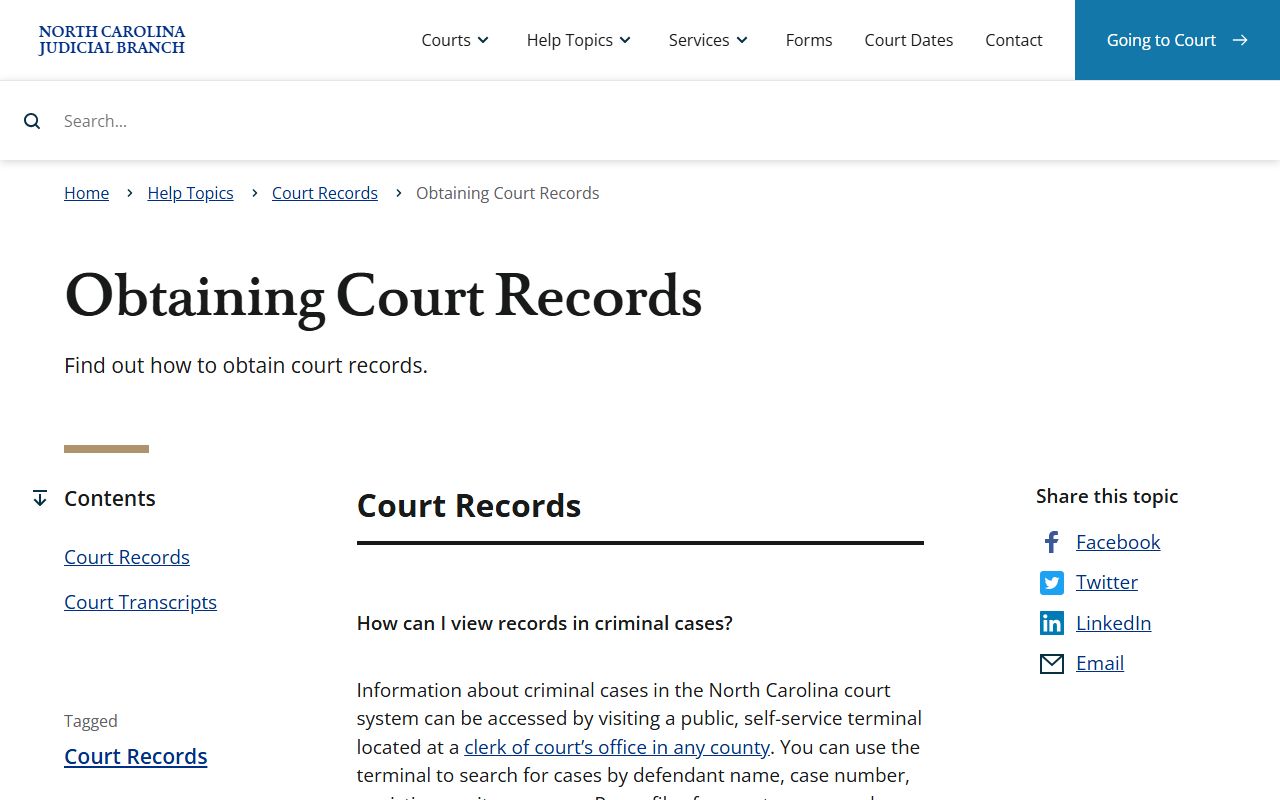
That state page is the correct source for case records, while the sheriff roster remains the source for current local custody.
Forsyth Court Record Search Fields
The court search path has more verified fields than the jail roster research because the Judicial Branch publishes Portal and terminal guidance. Use the broadest identifiers first, then narrow by case number or hearing details when available.
| Field Label | Type | Required | Notes |
|---|---|---|---|
| Case number | Text | Optional | Used for case and hearing searches. |
| Party name | Text | Optional | Portal person or defendant search path. |
| Business name | Text | Optional | Portal hearing search option. |
| Attorney name | Text | Optional | Portal hearing search option. |
| Attorney bar number | Text | Optional | Portal hearing search option. |
| Judicial officer | Text/dropdown | Optional | Portal hearing search option. |
| Courtroom | Text/dropdown | Optional | Portal hearing search option. |
| Victim or witness name | Terminal search | Optional | Named by Judicial Branch for public terminals. |
Charges After a Forsyth County Arrest
Charging documents are the bridge between jail arrest information and court records. Booking starts at the jail. The case record begins when the appropriate charge document enters the court system. The research identifies complaint, information, and indictment as useful plain-English categories to explain how charges may appear after arrest.
| Document | Who Uses It | What It Means |
|---|---|---|
| Complaint | Law enforcement or prosecutor process | Begins or supports a criminal accusation after arrest. |
| Information | Prosecutor | A prosecutor-filed charge document used in some procedures. |
| Indictment | Grand jury and prosecutor | A felony charging document commonly tied to superior-court process. |
Forsyth Charge Status Records
Charge status can change as a case moves. Pending does not mean convicted. Dismissed does not mean the arrest never happened. Amended or reduced charges mean the court record may no longer match the wording shown during booking. The District Attorney, not jail staff, controls prosecution decisions after review of facts and law-enforcement submissions.
| Status | What It Means |
|---|---|
| Pending | The case or charge remains open. |
| Dismissed | The charge ended without conviction. |
| Amended or reduced | The prosecutor or court changed the charge wording or level. |
| Indicted | A grand jury returned a charging document, usually in felony superior-court process. |
| Disposition | The current or final outcome of the charge. |
| Conviction | A finding or plea of guilt, not the same as arrest. |
Forsyth District Attorney Records Role
Forsyth County is in Prosecutorial District 31. The NC Conference of District Attorneys page lists Jim O'Neill as District Attorney, and the court directory lists the District Attorney phone as 336-779-6310. The DA prosecutes criminal cases after arrest. Jail staff do not decide whether charges are filed, dismissed, amended, reduced, or indicted.
The District Attorney page is part of the official research image set.
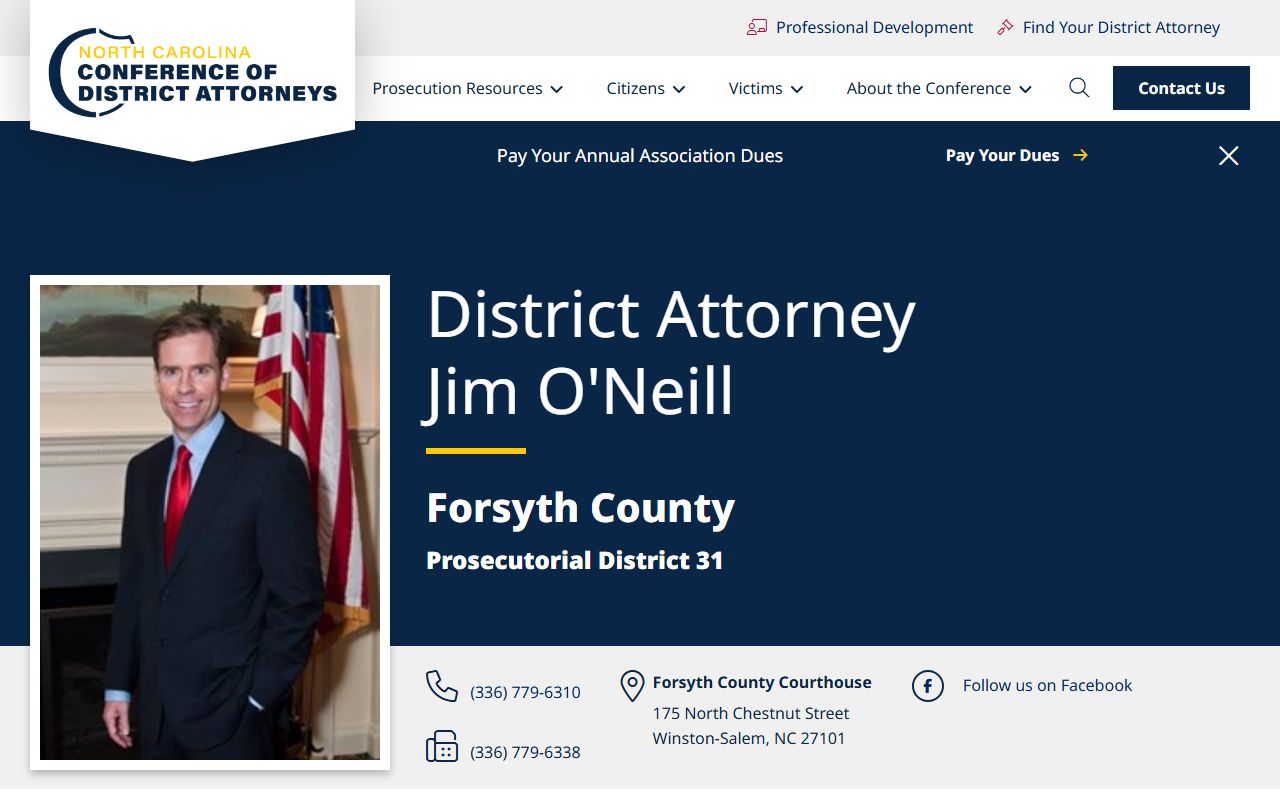
The DA source supports the court-record distinction: prosecution questions belong with court and prosecutor channels, not the jail roster.
Bond Records After a Forsyth Arrest
North Carolina release conditions are set under state criminal procedure, including G.S. 15A-534. A judicial official may impose a written promise to appear, custody release, unsecured bond, secured bond, house arrest with electronic monitoring where authorized, or other conditions designed to assure appearance and public safety. The research did not locate a Forsyth-specific bail schedule, so bond content should not invent one.
| Release Condition | Local Meaning |
|---|---|
| Written promise to appear | Release based on a written obligation to appear in court. |
| Custody release | Release to a responsible person under court conditions. |
| Unsecured bond | A money amount is set, but no upfront secured payment is required unless conditions are violated. |
| Secured bond | Cash, property, or surety must secure release before the jail can release the person. |
| No-bond or hold | Ordinary payment will not produce release until a court order or hold changes. |
Warrants and Arrest Court Records
Forsyth sheriff P2C includes Wanted Persons and Most Wanted Persons modules, and the Daily Bulletin may show warrant-related activity when posted. Bench warrants and failure-to-appear issues may also appear in court records. Once a person is arrested on a warrant, the booking may show in P2C, while the court record shows the underlying case and next hearing. A warrant or detainer from another county, probation/parole, federal court, or another agency can block release even when a local bond looks payable.
Charge vs Conviction Records
A Forsyth County arrest charge is an accusation or process step. A conviction is a court outcome. Treating a booking charge as a conviction is a serious error, especially when the case is pending, dismissed, or amended. Court records after arrest should be read for status and disposition before any legal conclusion is drawn.
| Charge | Conviction | |
|---|---|---|
| Stage | Accusation or filed count | Final or current guilt outcome after plea, trial, or judgment |
| Source | Booking record, warrant, complaint, information, or indictment | Court disposition or judgment |
| Can change? | Yes, it may be amended, reduced, added, or dismissed | May change through appeal, correction, or post-judgment relief |
Sealed and Expunged Court Records
North Carolina public-records law is broad, but public access is not unlimited. Juvenile information, sealed records, expunction orders, restricted victim data, medical information, and criminal-investigation material may be withheld or removed from ordinary public access. Expunction is the court process that can remove eligible arrest, charge, or conviction information from public access after a court order.
| Sealed | Expunged | |
|---|---|---|
| Public visibility | Hidden from ordinary public access | Removed from public access under a court order |
| Who controls it | Court order and record custodian rules | Court expunction process and agency updates |
| What to verify | Whether the record is restricted | Whether the expunction order has been entered and applied |
Important: Court records should not be used for employment, housing, credit, insurance, or other FCRA-covered decisions from this site.